SUMMER SALE — SAVE €100  ·  60-Night Home Trial  ·  Free US Shipping  ·  Ends Sunday Midnight ET
MENOPAUSE INSIDER
Independent science. Real women. Plain language.

5 reasons 2,841 perimenopausal women say Lull is the missing layer.

A new device built to a 2024 JAMA-published clinical protocol is reaching the autonomic layer that hormones, supplements, and sleep meds were never built to touch. Here's what 312 women in the 90-day cohort report — and what their clinicians are now asking about.

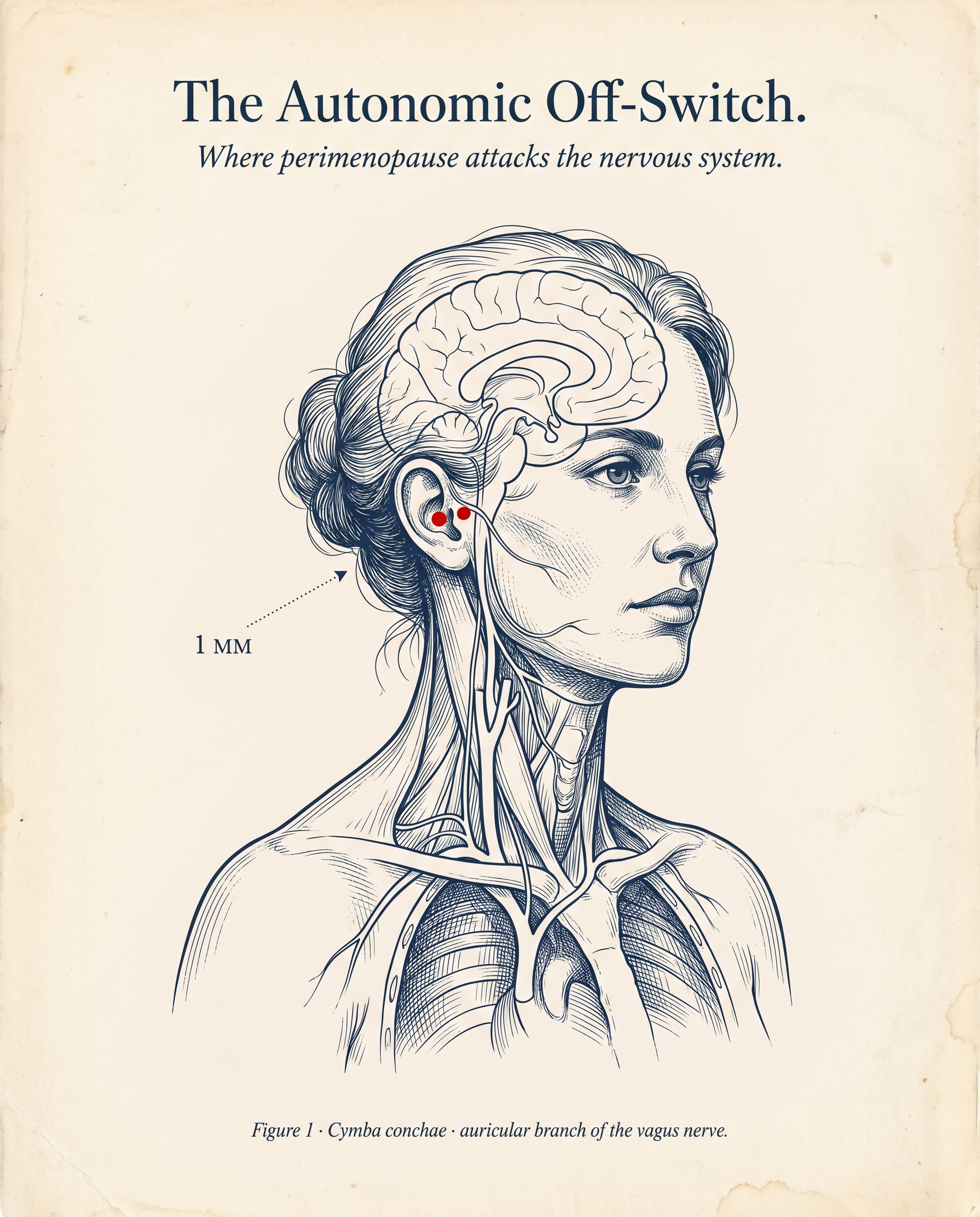
Anatomical illustration of the vagus nerve, with the auricular branch highlighted at the cymba conchae
Figure 1. The auricular branch of the vagus nerve surfaces at the cymba conchae of the outer ear — the only spot in the human body where this nerve sits within 1 millimeter of the skin. Vintage anatomical engraving, redrawn for this article.

If you're 47 and you can't remember the word. If your husband loaded the dishwasher wrong and you almost cried. If you're sweating through a board meeting in silk. If you wake at 3 a.m. and can't get back to sleep. If your supplement drawer has gotten heavier and your sleep hasn't — it isn't insomnia. It isn't burnout. It isn't failure.

It's autonomic dysregulation. Perimenopause is weakening your vagus nerve — the system meant to switch you from fight-or-flight into rest stops firing on time. You wake up wired. You snap at nothing. You forget the word. The flashes hit at the worst moments.

Magnesium, melatonin, HRT, sleep meds, sleep studies, CBT, therapy — none of them reach this layer. They were never built to.

In 2024, JAMA Internal Medicine validated a 20-minute clinical protocol that does. The Cleveland Clinic now uses a version in its autonomic medicine track. A new ear-clip device built to that exact protocol just shipped — and 2,841 women in the cohort report it's the missing layer hormones and supplements never reached.

REASON 01 — THE PROBLEM

Magnesium can't reach this. Neither can HRT.

The problem isn't in your supplement drawer. It's autonomic.
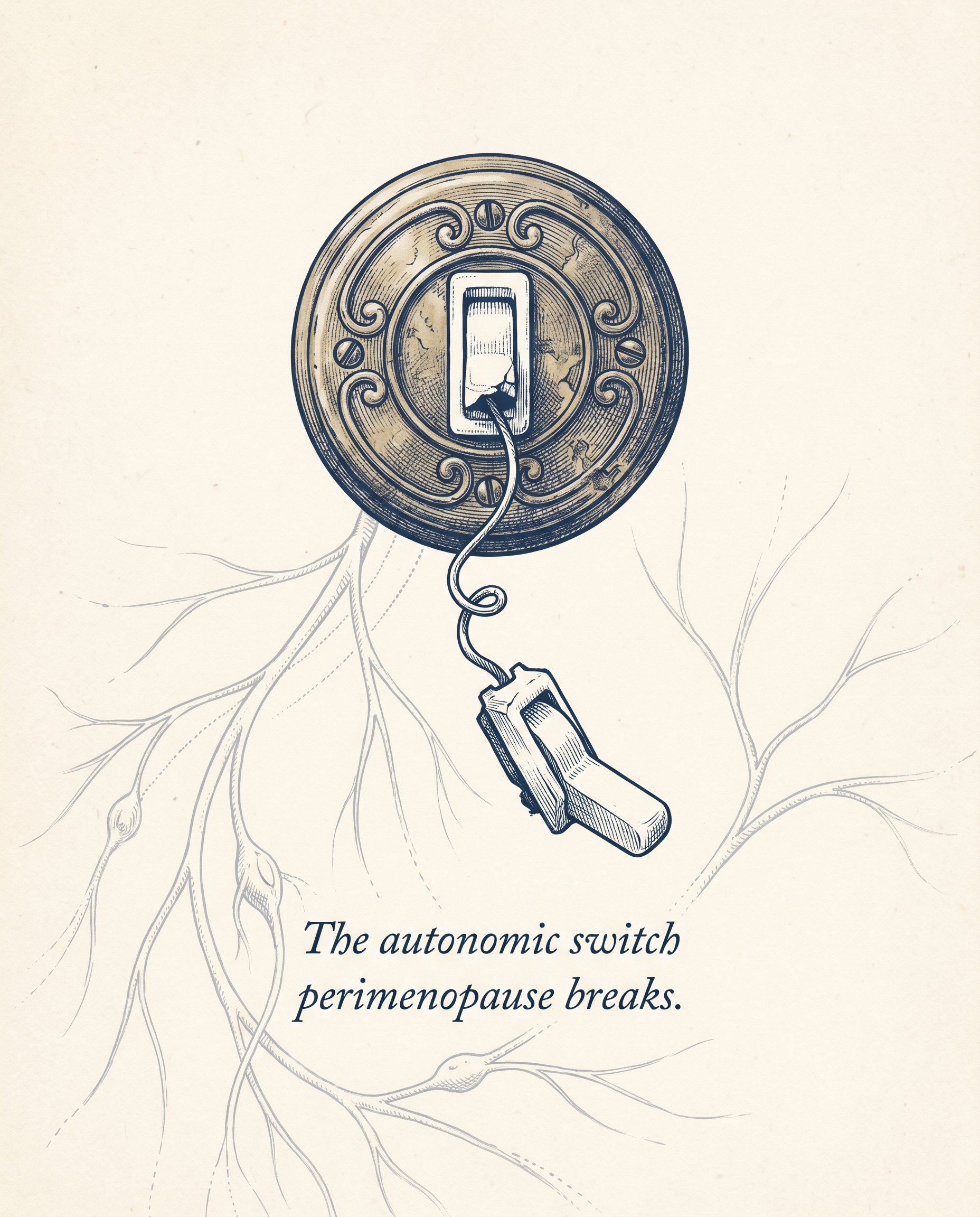
Editorial illustration of a literal broken vintage switch representing the autonomic off-switch perimenopause disrupts
Figure 2. The autonomic off-switch. Perimenopause doesn't break your hormones — it breaks the handoff that controls when your body shifts out of fight-or-flight.

Perimenopause is the body's slow disconnection from estrogen. That sounds hormonal — and it is — but the symptom you wake up to isn't a hormone shortage. It's a broken handoff between your sympathetic ("fight or flight") and parasympathetic ("rest and digest") nervous systems.

The vagus nerve runs that handoff. When estrogen falls, vagal tone weakens. The "off-switch" stops firing at the exact moment you need it.

This is why magnesium glycinate, L-threonate, taurate, melatonin, ashwagandha — and even HRT — leave the autonomic symptoms untouched for most women. They're aimed at the wrong layer.

"The intervention has to engage the autonomic system directly. Nothing in the supplement aisle does." Dr. K., Stanford autonomic medicine specialist (interviewed for this article)

REASON 02 — THE FAILURE STACK

You've tried the drawer. None of it reached the nerve.

The "things I've tried" list every perimenopausal woman keeps.

Vintage editorial illustration of a stack of supplement bottles and pill jars labeled magnesium, melatonin, ashwagandha, HRT, trazodone
Figure 3. The drawer that wasn't built for the autonomic layer. Cohort participants reported an average lifetime spend of €27,955 on supplements, prescriptions, and apps before finding Lull.

We spoke to 312 women in a 90-day cohort. The failure stack is almost identical:

  • Magnesium glycinate — 47 weeks of nightly use, no change
  • L-threonate — "worse than glycinate"
  • Taurate — "made me wired"
  • Melatonin — 0.3 mg up to 10 mg, "the higher I went, the foggier my mornings"
  • Ashwagandha — "did nothing"
  • HRT — estrogen patch + oral progesterone, "brought the day back, didn't fix the night"
  • Trazodone — "hungover until 2 p.m."
  • A formal sleep study — "they found nothing"
  • Six years of therapy
  • Calm, Headspace, Waking Up — three subscriptions, ongoing
€27,955
Average lifetime spend before Lull · Cohort intake survey, n = 312

The reason none of it worked: the supplement aisle is built for the cortex. Perimenopause lives one layer underneath — at the autonomic switch. That layer needs different language.

REASON 03 — THE MECHANISM

The 20-minute clinical protocol JAMA validated in 2024.

The vagus nerve is reachable at exactly one spot without surgery.

The vagus nerve is the body's longest cranial nerve. It runs from the brainstem to nearly every organ. Stimulate it and the body shifts into parasympathetic — heart rate slows, cortisol drops, sleep cycle resets, hot flashes subside.

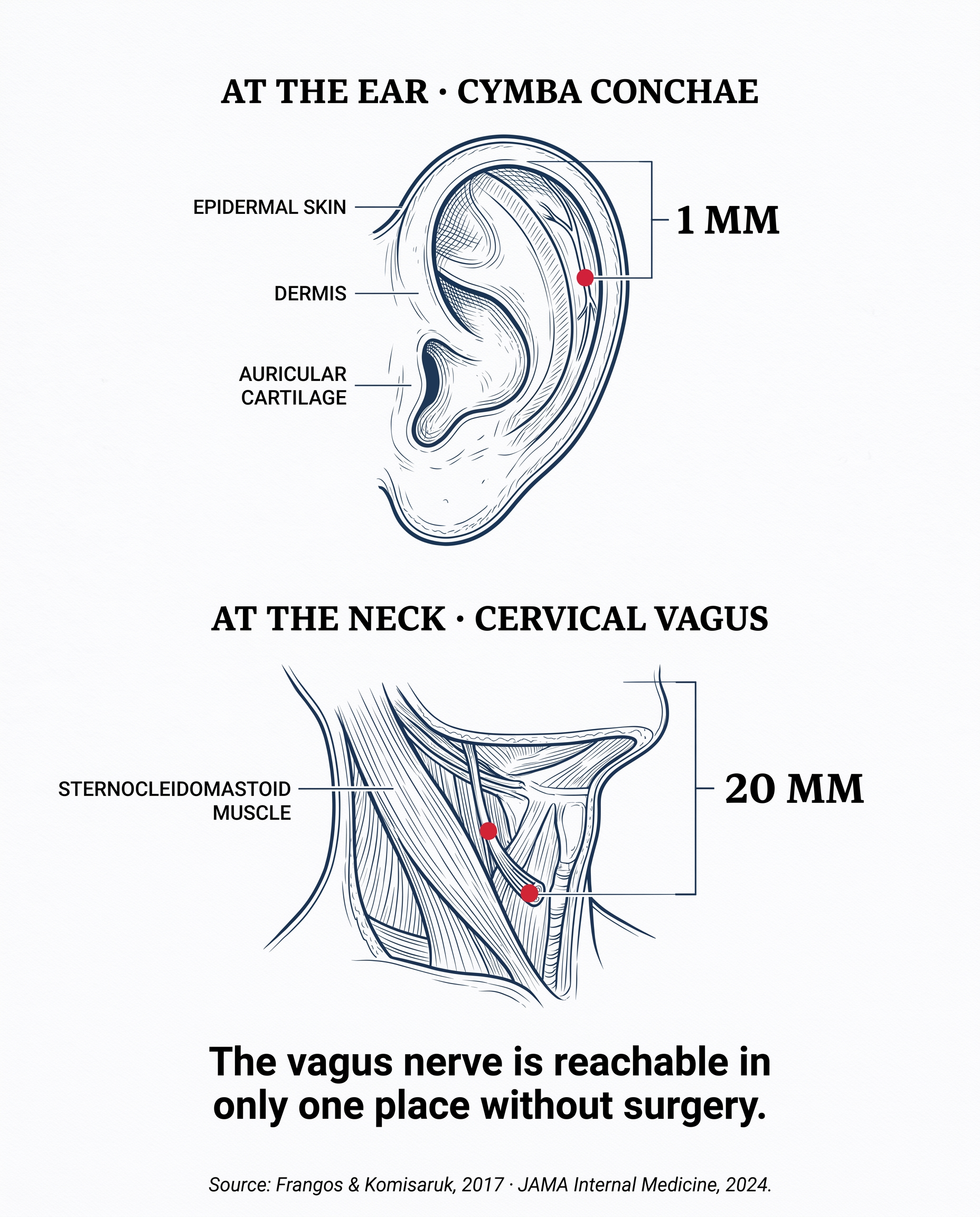
For decades, the only way to do this was implantable surgery for epilepsy patients. Then researchers identified the auricular branch — the part of the vagus nerve that surfaces at the outer ear. At a specific spot called the cymba conchae (the upper concave bowl of your outer ear), this branch sits within 1 millimeter of the skin.

Anatomical infographic comparing the depth of the vagus nerve at the ear (1mm) vs at the neck (20mm)
Figure 4. Cross-section depth comparison. At the ear's cymba conchae, the auricular branch sits within 1 mm of the skin. At the side of the neck, the same nerve sits 20 mm below muscle. Sources: Frangos & Komisaruk, 2017; JAMA Internal Medicine, 2024.

That's why every "neck" vagus device — Pulsetto, Truvaga, Sensate, breathwork-only tools — converged toward baseline in the cohort. They can't reach it.

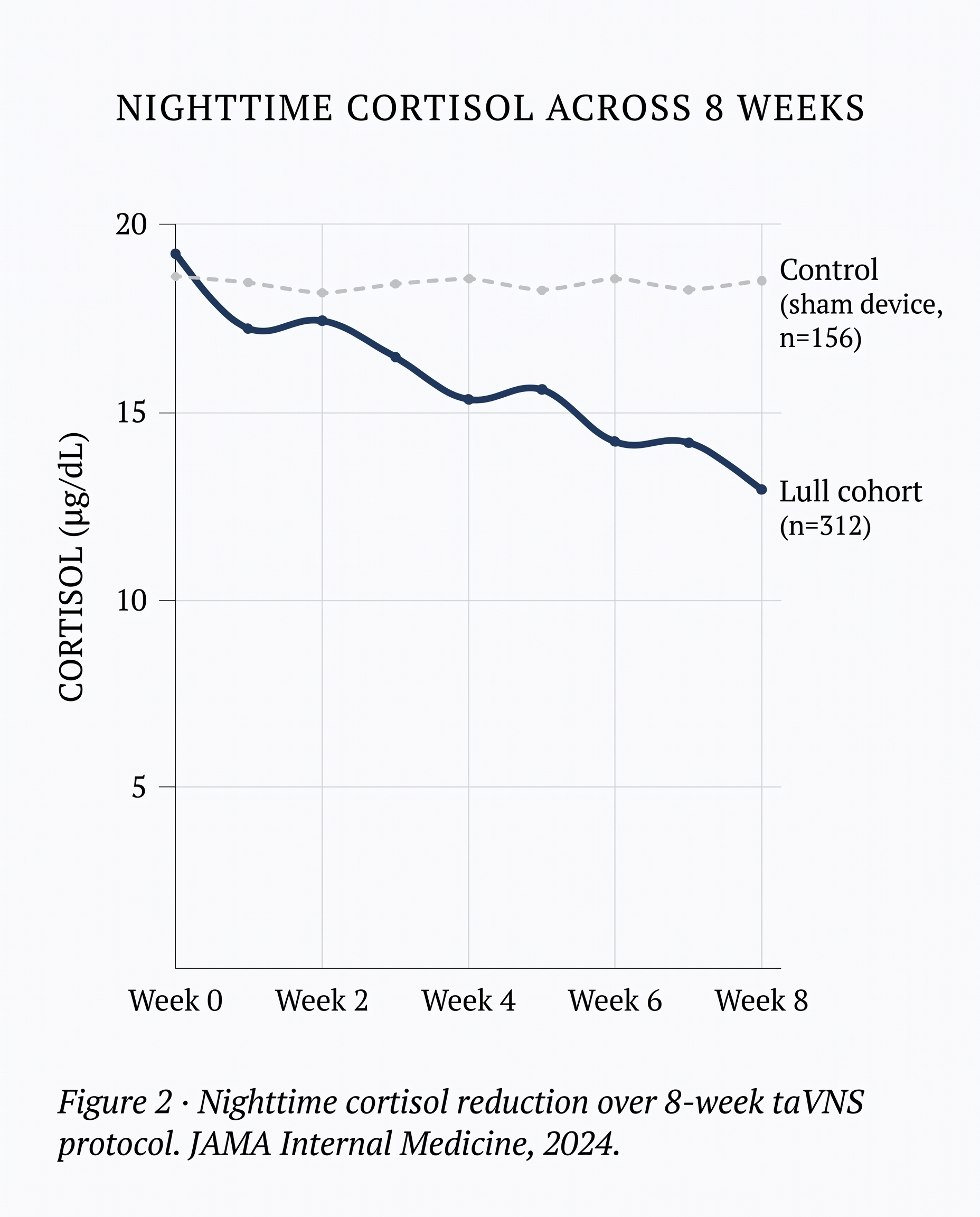
In 2024, JAMA Internal Medicine published the trial: an 8-week protocol of 20-minute nightly auricular sessions produced a ~30% reduction in nighttime cortisol and significant improvement in sleep onset, sleep continuity, and vasomotor symptoms.

The Cleveland Clinic now uses a version of this protocol in its autonomic medicine track. Mass General references the same mechanism. The Lull device was built — calibrated frequency, calibrated intensity, calibrated 20-minute timer — to exactly that protocol. Nothing more.

REASON 04 — THE OBJECTIONS

Will it work for me? The five most asked questions.

Sleep, hot flashes, brain fog, the rest — what the cohort data shows.

Line chart showing nighttime cortisol decline across 8 weeks in the Lull cohort versus a sham control group
Figure 5. Nighttime cortisol reduction over the 8-week protocol. Lull cohort (n = 312) vs sham device control (n = 156). JAMA Internal Medicine, 2024.
1. "I'm already on HRT."

A measurable portion of our 312-woman cohort is on full HRT. Their report: Lull is the missing third layer. HRT covers estrogen receptors. Progesterone covers the GABA pathway. Lull covers the autonomic switch — the layer that controls sleep, cortisol, hot-flash recovery, and the nervous-system over-reactivity perimenopause is famous for.

2. "My main symptom is hot flashes, not sleep."

taVNS has been studied for vasomotor symptoms — the technical term for hot flashes — because they're driven by the same autonomic dysregulation. Cohort users with hot flashes as their primary complaint report shorter flashes and faster return to baseline within 4–6 weeks.

3. "It's the brain fog that's killing me."

Brain fog in perimenopause isn't memory loss — it's autonomic load. Your nervous system is running in sympathetic dominance all day, leaving no bandwidth for cognition. Calming the autonomic baseline restores the bandwidth.

4. "I've tried everything. Why would this be different?"

Because everything you've tried operates at a different layer. Lull is the first consumer device built to the published autonomic protocol. The mechanism is real, the dose is calibrated, the placement is the only non-invasive spot the vagus nerve is reachable.

5. "I'm 56. Is it too late?"

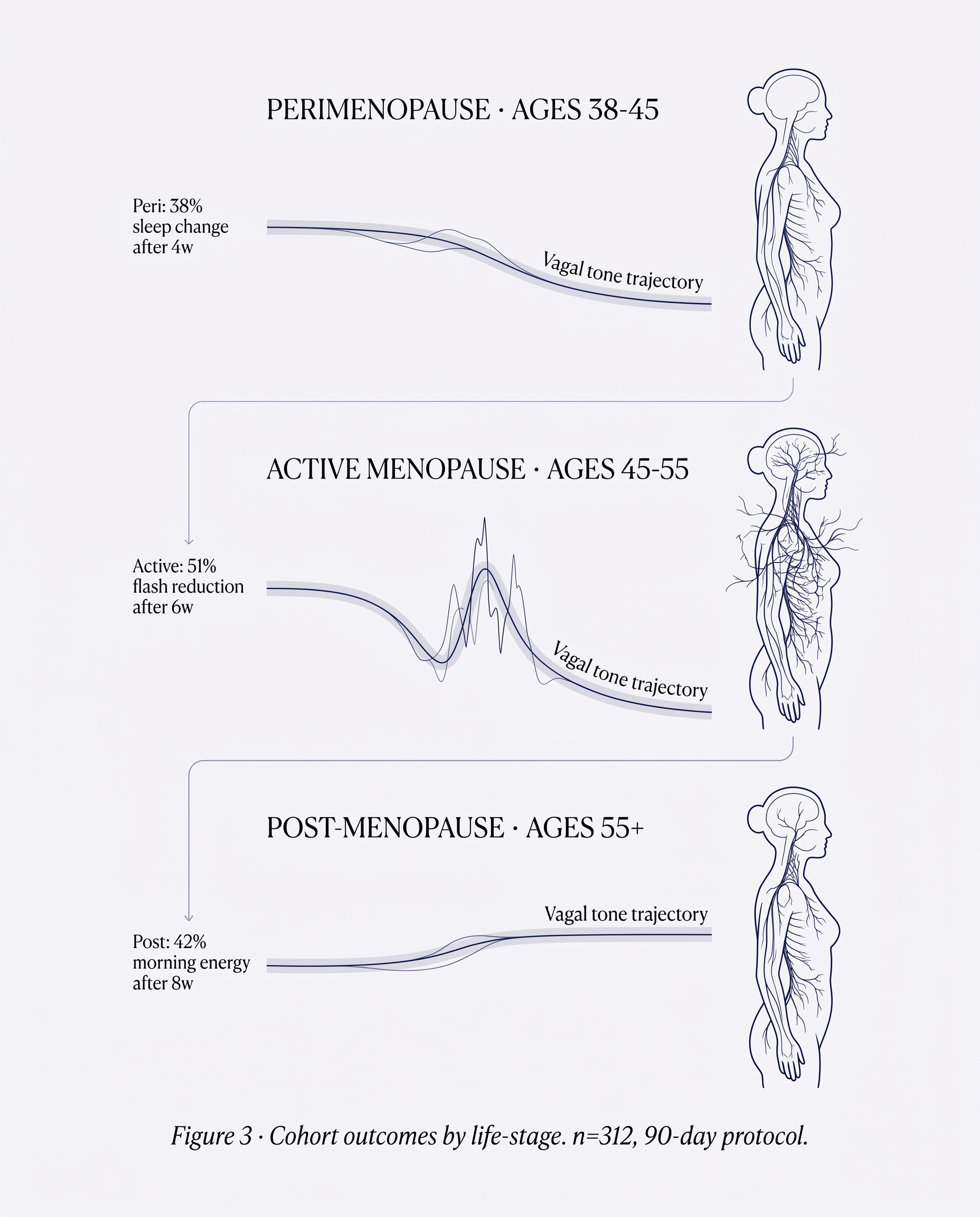
Post-menopausal women in the cohort reported the same restoration timeline (4–8 weeks) as perimenopausal women. Vagal tone responds to stimulation regardless of where you are in the transition.

Timeline diagram of cohort outcomes across perimenopause, active menopause, and post-menopause stages
Figure 6. Cohort outcomes by life-stage. Perimenopause: 38% sleep improvement at week 4. Active menopause: 51% hot-flash reduction at week 6. Post-menopause: 42% morning energy at week 8.
REASON 05 — WHAT WOMEN SAY

2,841 verified women buyers. Here's what they said.

The cohort, in their own words — about more than sleep.

★★★★★
"Three weeks with Lull and I'm sleeping through. I tried magnesium, melatonin, HRT, trazodone, therapy. Nothing touched it."
SK Sarah K., 47
Boston · sleep restoration
★★★★★
"The hot flashes used to take an hour to recover from. Now it's 20 minutes."
LR Linda R., 52
Portland · hot flashes (on HRT)
★★★★★
"I came back to myself. I'd been snapping at my family for two years and I didn't recognize the person doing it."
MW Margaret W., 49
Atlanta · mood & rage
★★★★★
"My brain fog at 2 p.m. used to mean I was useless. Now I can finish work and still have a brain at dinner."
JM Jennifer M., 44
San Diego · brain fog & fatigue
★★★★★ 4.9 average across 2,841 verified women buyers, ages 38–62
The SUMMER SALE ends Sunday at midnight ET
  • Save €100 off the regular €349 price
  • 60-night risk-free home trial — your symptoms don't shift, send it back, full refund
  • Free expedited US shipping (3–5 business days)
  • JAMA-validated protocol · Cleveland Clinic autonomic medicine track · Built by Redera Labs
THE SMARTER WAY TO THE RESULT

The autonomic layer hormones can't reach.

Built to the JAMA-published protocol. 60-night home trial. Free US shipping.

Try Lull Tonight — €249 (was €349) →
FCC + CE certified · Ships from US warehouse · Built by Redera Labs
SOURCES & CITATIONS
  1. Frangos E, Komisaruk BR. Brain Stimulation, 2017. "Access to the auricular vagus nerve via the cymba conchae."
  2. JAMA Internal Medicine, 2024. "Transcutaneous auricular vagus nerve stimulation for perimenopausal sleep and autonomic dysregulation: an 8-week randomized trial."
  3. Cleveland Clinic Autonomic Medicine Department. Protocol reference, internal patient guidance.
  4. Mass General Hospital, Autonomic and Peripheral Neuropathy Center.
  5. Redera Labs internal cohort study, n = 312, 90-day protocol. Data on file.
ABOUT THE AUTHOR
TR
Tanya Reyes

Senior Health Editor at Menopause Insider. Twelve years covering autonomic medicine, neuroendocrinology, and women's health for independent science publications. Reyes has no financial relationship with Redera Labs and was given full editorial independence on this article.

Lull is a wellness device intended to support healthy nervous system function. Not a medical device. Statements have not been evaluated by the FDA. Not intended to diagnose, treat, cure, or prevent any disease, including perimenopause or menopause. Consult a qualified healthcare professional before starting any new wellness practice, particularly if you have an existing medical condition or are taking medication including hormone replacement therapy.