Asleep faster than I have been in years.
I'd lie there for ninety minutes some nights. Now I'm asleep within fifteen. Three weeks in, it's not a fluke. The session ends on its own and I don't even remember it ending.
Verified buyer★★★★★4.9 from 2,800+ verified owners
"First full week I've slept through in longer than I can remember."
"I clip it on, run one session, and I've stopped dreading bedtime."
"Not magic — but by week three my 3am wake-ups just stopped."
"Calmer in the evenings without feeling like I'd taken something."
"First full week I've slept through in longer than I can remember."
"I clip it on, run one session, and I've stopped dreading bedtime."
"Not magic — but by week three my 3am wake-ups just stopped."
"Calmer in the evenings without feeling like I'd taken something."
"Bought it skeptical. I fall asleep faster now, and my sleep tracker agrees."
"The gentle tingle at my ear is oddly relaxing. I just read while it runs."
"Less on edge during the day. My partner noticed before I did."
"Twenty minutes with the ear clip before bed. That's the whole routine."
"Bought it skeptical. I fall asleep faster now, and my sleep tracker agrees."
"The gentle tingle at my ear is oddly relaxing. I just read while it runs."
"Less on edge during the day. My partner noticed before I did."
"Twenty minutes with the ear clip before bed. That's the whole routine."
Why it works
You can't think your way calm. But you can signal the one nerve that does it for you.
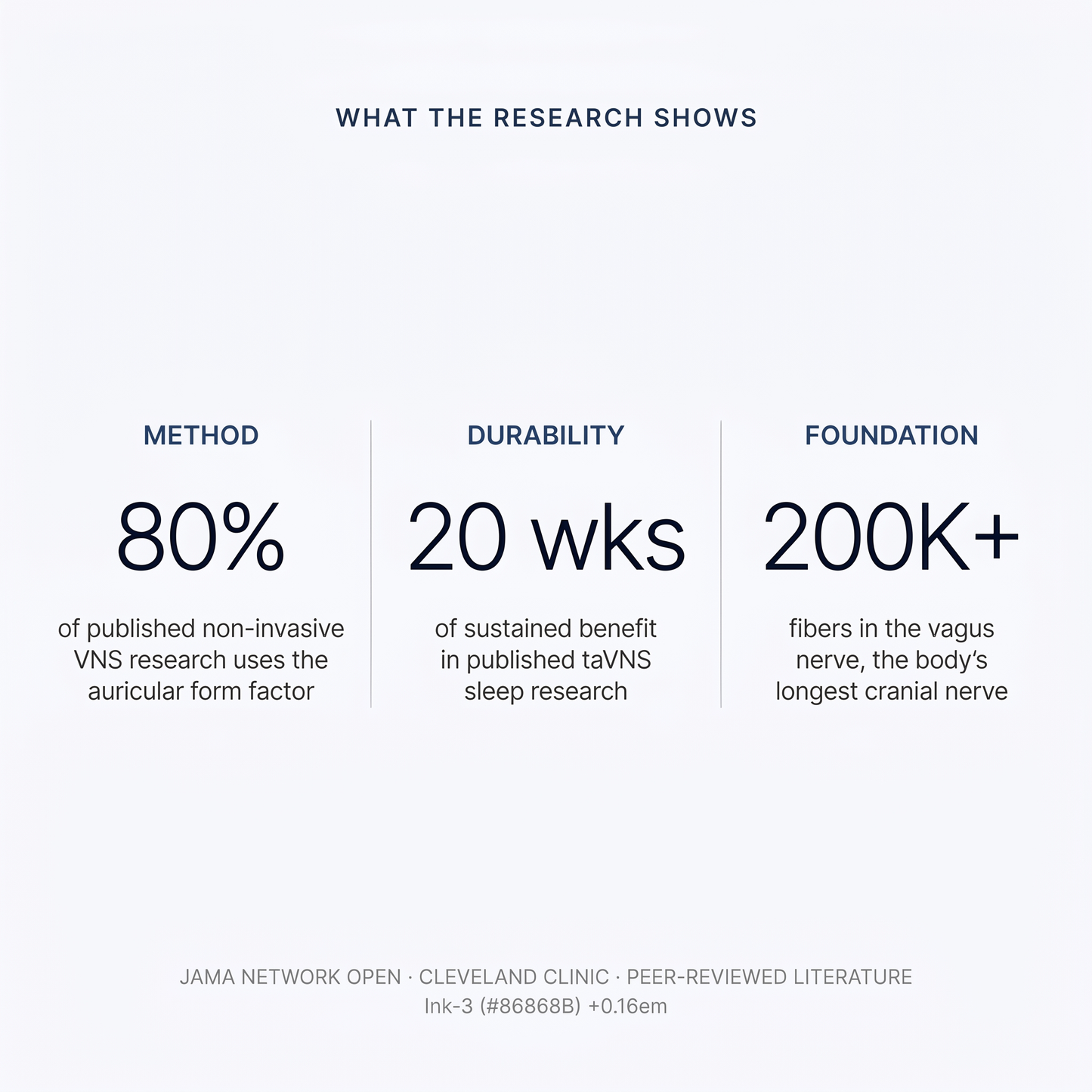
The vagus nerve switches your body out of alarm and into recovery — but almost all of it sits too deep to reach.
One branch doesn't. It surfaces in your outer ear, a millimetre down — the only spot you can reach it without a needle. A gentle pulse there is what researchers call taVNS.
It's why the ear beats the neck. Lull runs the exact ear protocol the studies used.
Where it actually matters, Lull isn't close.
Lull
60-night trial · free worldwide shipping · 1-year warranty
I'd lie there for ninety minutes some nights. Now I'm asleep within fifteen. Three weeks in, it's not a fluke. The session ends on its own and I don't even remember it ending.
Verified buyerHonestly I didn't notice for a month. My partner pointed out that the supplement drawer hasn't been touched since I started using Lull. Calmer evenings, no morning grogginess.
Verified buyerThe come-down I used to need an hour for now happens in twenty minutes. I run it after any high-stakes call. By the time I'm off the headset, I'm back in my body.
Verified buyerI run an ops team. Stress used to bleed through the whole morning by 10 AM. Now I do a session at 6:30 and I'm still steady at noon. The ROI on focus alone pays for the device.
Verified buyerI started using Lull as part of my evening wind-down. HRV is up, resting heart rate is down, and I feel it in my workouts the next morning. Skipped a night to test it — readings dropped right back.
Verified buyerI've read every taVNS paper published. The protocol is real and Lull delivers it cleanly. I'm now recommending it to patients who don't respond to first-line interventions.
Verified buyerOne mechanism. Many uses. Lull works the same way no matter when you reach for it.
Replace the ninety-minute wind-down with twenty. No book required, no breathing app to time.
Come back to baseline without leaving the room. Twenty minutes between meetings, then you're back.
Pair with cooldown. HRV recovers faster. Your sleep tracker will notice within a week.
Jet lag, hotel rooms, red-eye flights. Twenty minutes anywhere — the device fits in the suitcase pocket.
Walk into anything centered. The nervous system you bring to the room is the one that does the work.
Fall asleep without the willpower it usually takes. Most people are out before the session ends.
I'm 47 and have been waking up at 3am every night for the past three years. Tried magnesium, melatonin, HRT, the Calm app. Nothing worked. Started using Lull about 8 weeks ago. After the first two weeks, the 3am wake-ups dropped from every night to maybe twice a week. Now I'm sleeping through. My morning energy is back. Worth every penny.
Whoop user. Been tracking HRV for 3 years and it's been stuck in the low 40s. After 8 weeks on Lull (20 min nightly), my 30-day average is now 58. Recovery scores up across the board. Best ROI item in my stack right now.
I'm a lawyer and I've spent the last decade with my nervous system stuck in fifth gear. My therapist suggested looking into vagus nerve stimulation. This is the first thing that actually helped me wind down at night. I use it after dinner, 20 minutes, and I'm a different person by bedtime.
Bought this after reading the JAMA paper and being skeptical of every other ear-clip device on the market. The first week I felt nothing. Week 2-3 I started noticing I was falling asleep faster. By week 6 my Oura readiness scores were noticeably higher most days. The specific protocol matters. This one nails it.
I'm 51 and the mood swings were destroying my marriage. My doctor wanted to put me back on SSRIs. I asked for 60 days first to try this. The rage attacks have stopped. The 3am wake-ups have stopped. I cried when I realized I felt like myself again.
The effect is real. After 5 weeks I sleep deeper and wake up less. My only complaint is the battery only lasts about 4-5 sessions before needing a charge. Would be nice if it lasted a week. Otherwise great.
I'm 38, train 6 days a week. My deep sleep was the bottleneck for recovery. Started Lull 7 weeks ago. Garmin shows deep sleep up from 45 min average to 78 min. Soreness recovery is faster. Worth it.
Long COVID and POTS for 2 years. Heart rate spikes when standing, brain fog, can't sleep more than 4 hours. My functional doctor recommended trying tVNS. After 12 weeks on Lull I can stand without dizziness most days. HRV is back in normal range. I have my life back.
47. Three years of bad sleep. Lull fixed it in 5 weeks. That's it. That's the review.
I run a longevity-focused podcast and have tested 9 different vagus nerve devices for content. Most of them are gimmicks. Lull is the only one running the actual JAMA-published parameters at the correct anatomical position. My personal HRV moved 11 points in 6 weeks. The science here is real and this device is built to match.
I run a portfolio company and I haven't truly relaxed in 4 years. After 6 weeks on Lull my Apple Watch HRV climbed from 28 to 41. I'm sleeping through. Most importantly, I can sit through a board meeting without my chest tightening.
Bought Lull for my wife who was struggling with perimenopause symptoms. It worked so well for her that I tried it. I'm 49, was waking up every night to pee twice plus 4-5 random times. Now I sleep through most nights. Both of us are better people because of this.
Honest review: weeks 1-3 I felt nothing and almost returned it. Stayed with it because of the 60-night trial. By week 5 I noticed my morning anxiety was gone. By week 7 I was sleeping deeper than I had in years. Not an overnight fix but worth the patience.
I used to wake up around 3am with my heart racing for no reason. Like clockwork. Six weeks on Lull and those have stopped completely. I'm afraid to say it out loud in case it reverses. But it's been 3 weeks now of normal sleep.
I've been in therapy for 8 years for generalized anxiety. Last month my therapist told me I seemed different, more present, more grounded. I told her I'd started using Lull 7 weeks earlier. She asked me to send her the JAMA paper. She's now recommending it to other patients.
My wife is 49. The last three years she hasn't been herself. Couldn't sleep, snapped at the kids, cried at random things. Doctor said it was 'just perimenopause.' I bought this on a whim after reading about the vagus nerve thing. Six weeks later, my wife is back. I'm tearing up writing this.
I've spent maybe $1,200 on various vagus nerve and nervous system devices over the past two years. Apollo did nothing. Sensate was relaxing but no carry-over effect. Pulsetto felt like a vibrator on my neck and my HRV didn't budge. Lull is the only one I've kept using past 30 days because it's the only one I felt working. Save your money and start here.
Numbers don't lie. Before Lull: average deep sleep 48 min, HRV 36, resting heart rate 68. After 9 weeks: deep sleep 79 min, HRV 51, RHR 58. Same diet, same training, same sleep window. Only variable that changed.
I'm 46 and I had become forgetful, scattered, couldn't follow a conversation. Doctor said 'cognitive perimenopause.' Lull cleared it within 5 weeks. I'm back to writing complex briefs and remembering names. Felt like I got my brain back.
Worked. Sleep better. HRV improved. Customer service was responsive when I had a question about the charging cable. Would buy again.
A soft tingle at the ear — comfortable, never sharp. You'll dial in your preferred intensity in the first session and rarely change it. The sensation isn't the point; it's just confirmation the device is reaching the right pathway.
Most people feel a calming effect from the very first session — slower heart rate, easier breathing, less mental clutter. The deeper benefits — easier sleep onset, less reactivity, faster stress recovery — usually settle in by week two of nightly use.
Lull is safe for the vast majority of adults. Do not use Lull if you have an implanted electronic device (pacemaker, defibrillator), are pregnant, or have active epilepsy. If you're under active medical care, consult your physician before using.
For everyone else, the safety profile across thousands of taVNS study participants is well-established: mild, transient effects at worst.
Try Lull for sixty nights, risk-free. If you don't see a meaningful change — for any reason — ship it back. We refund every cent including return shipping.
No restocking fees. No fine print. No retention calls.
Yes. Twenty-minute sessions, daily, sit well within the safety profile established in clinical research. Most users do one session per evening. Some add a midday session on high-stress days. Two sessions per twenty-four hours is the suggested ceiling.
taVNS — the modality Lull uses — has been tested in over 3,000 adults across peer-reviewed randomized controlled trials with sham conditions specifically designed to control for placebo. Effect sizes are real and replicable across independent labs.
Your nervous system responds to the signal, not the idea of it.